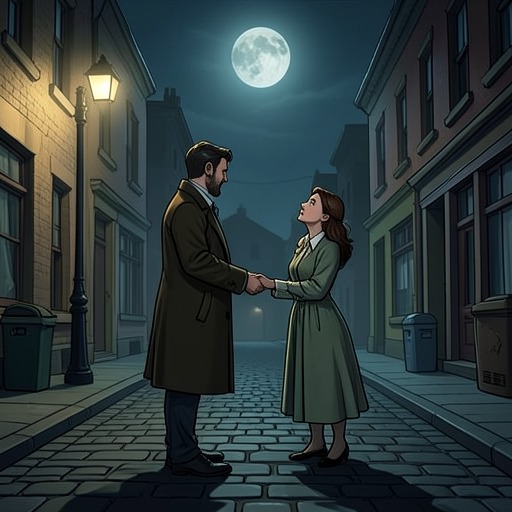
Poe’s Leonore poem
The Pale Blue EyePoe’s Leonore poem is a sheet of verse whose apparent prophecy becomes a test of how the living interpret signs of danger. Its movement from a shadowed encounter with a suffering woman to an image of her vanishing beneath darkness gives Poe grounds to fear for Lea Marquis; Augustus Landor, however, insists that the poem reveals Poe’s anxiety rather than supernatural knowledge. The poem matters not only for what it says, but for the struggle over who—or what—is speaking through it.
The poem as an object and performance
The poem first arrives as a physical sheet, not as a recitation. Asked whether he has fresh news, Poe searches his pockets for a minute before producing it. He unfolds the paper with the reverence of someone unpacking a chalice, and Augustus Landor accepts it without knowing what he is about to read. The careful handling makes the page feel charged before its words have been heard: Poe’s manner invites Landor to approach it as something more than ordinary writing.
The first passage places its speaker in a “dream-shadowed weir,” trembling under Night’s “loathsome stole.” He addresses Leonore, asking how she came to a bleak and dank shoal; she replies fearfully that she hardly dares speak of Hell’s toll and of demons who ravaged her soul. The paired descriptions—“bleak unaccountable” and “dank undesirable,” “devils who ravished” and “demons who ravaged”—leave the distress emphatic while giving the printed passage a sense of verbal alternatives. The poem offers an atmosphere of suffering, but no account that would settle its cause.
Landor cannot find an answer to the page. He searches his mind and comes up empty, finally telling Poe, “It's nice,” and then, “Really, Mr. Poe. Very nice.” His mild response contrasts with Poe’s ceremony of presentation. At this first encounter, the poem’s effect lies as much in the gap between the author’s solemn expectation and Landor’s inability to interpret it as in its dark imagery.
Darkness, disappearance, and the blue eye
When Poe presents the poem again, he spreads the sheet across a bed, smoothing its creases as if unfurling a shroud. The gesture gives the page a funereal aspect before the new passage describes a woman being overtaken. A “hot thrashing flurry” of wings descends, too obscure to see; the speaker begs Leonore to hurry, but she does not reply. Endless Night catches her, “Shrouding all but her pale blue eye,” and the stanza ends by leaving “only that deathly blue eye.”
The eye is the passage’s last visible remnant of Leonore. Darkness does not simply surround her; it progressively removes her from view until the eye alone remains, and then the poem repeats that image as its concluding line. This narrowing from a whole person to a single feature supplies the poem with its most arresting movement. It also gives Poe a point of correspondence with Lea: as he explains, Leonore and Lea have closely resembling names, and both are associated with blue eyes.
Poe’s prophetic reading and Landor’s reply
Poe begins interpreting the second passage before Landor has finished reading it. He connects the resemblance between the names, the shared feature of blue eyes, and the poem’s suggestion of “unspeakable distress” with Lea’s behavior in the cemetery. From those correspondences he draws a conclusion: the poem announces an imminent end and demands urgency. For Poe, the verse is not merely about fear; it appears to convey knowledge of what may happen to Lea.
Yet Poe cannot turn that alarm into a practical course of action. When Landor asks what they should do, Poe answers that he does not know. He describes himself as a conduit for the poem, unable to fathom its deeper meanings. His confidence that the poem speaks and his inability to explain what it requires stand side by side: the verse seems urgent to him, but offers no clear instruction beyond that urgency.
Landor rejects the supernatural explanation directly. He tells Poe that Poe himself wrote the poem, not Poe’s deceased mother and not “some supernatural scribbler.” He then supplies a psychological account: Poe has Lea on his mind day and night, has reason to fear for her safety after their brief history, and has expressed that fear through poetry, his favored form of expression. Landor’s interpretation does not dismiss the poem’s distress; it relocates its source from an outside prophetic voice to the author’s own apprehension.
Significance in the investigation
The poem’s clues are compelling because they are also open to ordinary explanation. Leonore’s name resembles Lea’s, the poem’s surviving eye is blue, and its language of distress recalls what Poe sees in Lea’s conduct at the cemetery. Those correspondences sharpen his fear, but they do not establish that the verse predicts an event. Landor treats the same details as evidence of Poe’s concern rather than evidence of supernatural authorship.
That disagreement makes the poem an interpretive object within the investigation: its words can be read as a warning from beyond the author or as an indirect disclosure of what the author already fears. Its repeated presentation reinforces that tension. First Poe offers a vision of a tormented woman; later the poem’s darkness leaves a blue eye as its final image, and Poe reads that image against Lea. The page gives his alarm a form, while Landor’s response insists that the form has a human author and a human cause.